

North Carolina Home Inspector License #1824
D & D Home Inspection ServicesPublished: September 22, 2026
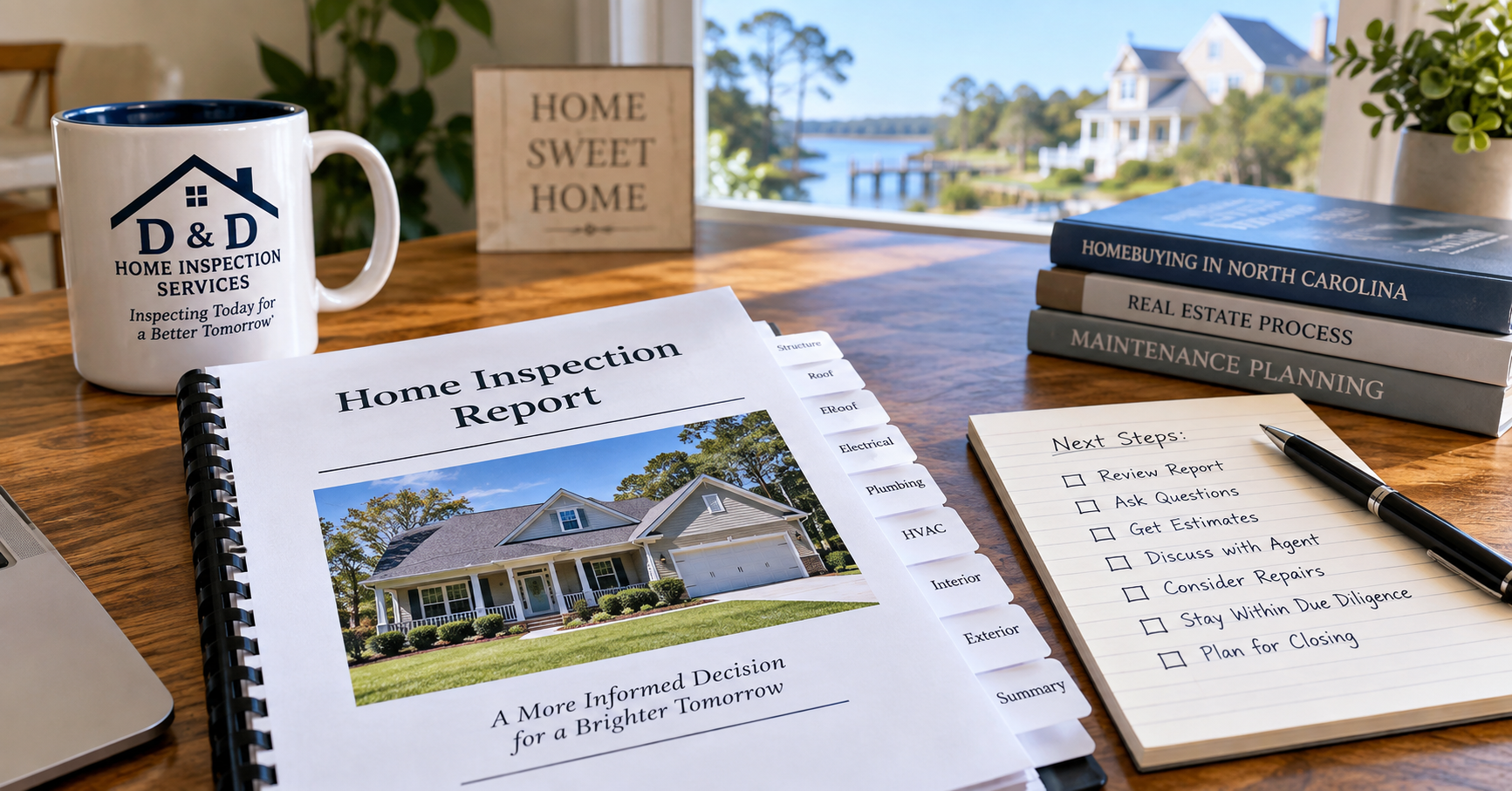
If you are buying a home in North Carolina, receiving the home inspection report is not the end of the inspection process. In many ways, it is the point where some of the most important decisions begin.
After the inspection, buyers should carefully review the entire report, identify significant concerns, obtain additional evaluations when necessary, consider their due diligence deadline, and work with their real estate agent or attorney to decide how the findings affect the purchase.
The inspection itself does not decide whether you should buy the house. Instead, it gives you information about the visible and accessible condition of the property so you can make a more informed decision.
Key Takeaways: What Happens After Your Home Inspection?
- Read the entire inspection report—not only the summary.
- Separate major concerns from routine maintenance items.
- Ask your inspector questions about findings you do not understand.
- Arrange specialist evaluations when the report recommends them.
- Pay close attention to your North Carolina due diligence deadline.
- Discuss repair requests or other options with your real estate agent or attorney.
- Remember that repair requests are generally negotiable.
- Verify agreed-upon repairs before closing.
- Use the inspection report as a maintenance guide after purchasing the home.
Step 1: Receive and Read the Complete Home Inspection Report
After the physical inspection is completed, the home inspector prepares a written report documenting the systems and components inspected and any defects or concerns observed during the inspection.
Under North Carolina law, the report must be delivered by the date established in the inspection agreement. If the agreement does not specify a delivery date, the report must generally be provided within three business days after the inspection.
A qualifying pre-purchase inspection covering three or more systems also includes a summary page.
But there is an important point for buyers to understand:
The summary is not the entire inspection report.
Do not read only the summary and assume everything else is unimportant. The body of the report may contain additional observations, maintenance recommendations, limitations, photographs and conditions that deserve your attention.
Step 2: Do Not Treat the Home Inspection Like a Pass-or-Fail Test
A home inspection is not a pass-or-fail examination of a house.
Homes—especially older homes—often have multiple inspection findings. A report containing many observations does not automatically mean the property is a bad purchase, just as a shorter report does not guarantee that a house will never need repairs.
The more useful question is:
What do the findings mean for this particular house and this particular buyer?
Some findings may involve routine maintenance. Others may involve safety concerns, moisture intrusion, structural conditions, roofing defects, electrical problems, plumbing leaks, HVAC issues or components that require additional evaluation.
The purpose of the inspection report is to help you understand those conditions so that you can decide what deserves additional attention before closing.
Step 3: Separate Significant Concerns From Routine Maintenance
One of the first things buyers should do after receiving the report is place the findings into perspective.
A loose door handle and significant structural movement should not necessarily receive the same level of attention.
Likewise, an aging water heater may deserve planning for future replacement while an active plumbing leak may deserve more immediate investigation.
Items that may deserve closer attention include:
- Active water intrusion or plumbing leaks
- Structural movement or damaged structural components
- Electrical safety concerns
- Roof leaks or significant roof deterioration
- HVAC systems that are not functioning as intended
- Damaged or deteriorated floor framing
- High crawl-space moisture or standing water
- Unsafe decks, stairs or guardrails
- Evidence suggesting additional evaluation is needed
- Conditions that may require evaluation by a licensed specialist
This does not mean every item on that list automatically represents a major defect. The circumstances of the house, age of the components and severity of the condition all matter.
Step 4: Ask Your Home Inspector Questions
The inspection report should be understandable, but buyers should not hesitate to contact their inspector when something in the report is unclear.
Good questions may include:
- Can you explain what you observed?
- Why was this item included in the report?
- Does this condition need further evaluation?
- What type of specialist should evaluate it?
- Was the area completely accessible during the inspection?
- Is this something that should be monitored?
- Was there evidence of active moisture at the time of inspection?
Your inspector can explain the observation and why additional action may have been recommended.
The inspector’s role, however, is not to negotiate the real estate transaction for you or decide whether you should purchase the property.
Step 5: Schedule Any Recommended Specialist Evaluations Quickly
Some conditions cannot be completely evaluated during a general home inspection.
If the inspector identifies a concern that requires additional investigation, the report may recommend contacting an appropriately qualified specialist.
Depending on the condition, that could include a:
- Licensed electrician
- Licensed plumber
- HVAC contractor
- Roofing contractor
- Structural engineer
- Foundation or structural contractor
- Septic professional
- Well or water-testing professional
- Wood-destroying insect inspection professional
- Moisture or indoor environmental specialist
Do not automatically wait until after closing to obtain an important specialist evaluation if the information could affect your purchasing decision.
Your due diligence period may be limited, so follow-up inspections should generally be scheduled promptly.
Step 6: Pay Attention to Your North Carolina Due Diligence Deadline
This is one of the most important parts of the process for North Carolina homebuyers.
Under commonly used North Carolina real estate contracts, the due diligence period gives the buyer an opportunity to investigate the property and transaction. Home inspections are one of the investigations that commonly take place during that period.
The exact due diligence deadline is determined by your real estate contract.
That means a buyer should avoid receiving an inspection report and allowing it to sit unread for several days.
You may need enough time to:
- Review the report
- Ask the inspector questions
- Schedule contractors or specialists
- Obtain additional inspections
- Receive repair estimates
- Discuss the findings with your agent
- Decide whether to request repairs or other concessions
- Make other decisions permitted under your contract
Your home inspector does not control your due diligence deadline. Buyers should confirm contractual deadlines with their North Carolina real estate agent or attorney.
Step 7: Decide Which Inspection Findings Actually Matter to You
It can be tempting to create a repair request containing every item mentioned in the inspection report.
That is not always the most useful approach.
Many buyers choose to concentrate first on conditions involving safety, active water intrusion, structural concerns, significant system failures or potentially expensive repairs.
Routine maintenance and small cosmetic items may be lower priorities.
A useful way to evaluate an inspection finding is to ask:
- Is this a safety concern?
- Is the problem active right now?
- Could delaying repairs cause additional damage?
- Does a specialist need to investigate it?
- Could the repair be expensive?
- Does it affect an important system such as the roof, electrical, plumbing, HVAC or structure?
- Is this routine maintenance that I am comfortable handling after closing?
Every buyer has a different budget, comfort level and reason for purchasing a property. The inspection provides information; the buyer determines how important that information is to the transaction.
Step 8: Discuss Repair Requests With Your Real Estate Agent or Attorney
Finding a defect during a home inspection does not automatically require the seller to repair it.
In North Carolina, repair requests are generally a matter of negotiation between the buyer and seller.
A buyer may decide to request repairs, request additional information, seek another form of negotiated resolution or proceed with the property in its current condition, depending on the terms of the contract and circumstances of the transaction.
The seller may agree to some requests, reject them or offer an alternative.
Because these decisions involve your real estate contract, your home inspector should not be the person advising you how to structure a repair request.
Discuss the contractual and negotiation side of the process with your North Carolina real estate agent or attorney.
Step 9: Get Repair Estimates When Necessary
An inspection report identifies property conditions, but buyers may still need to determine the potential cost of correcting significant defects.
This is where qualified contractors and specialists become important.
For example, if the inspection identifies significant electrical concerns, having a licensed electrician evaluate the system may provide more information about the necessary repairs and potential costs.
The same principle applies to roofing, plumbing, HVAC, structural and other specialized concerns.
A realistic contractor estimate can help you understand the financial significance of a condition much better than simply guessing what a repair might cost.
Step 10: Consider a Wood-Destroying Insect Inspection Separately
North Carolina buyers should understand that a general home inspection and a wood-destroying insect inspection are not necessarily the same inspection.
A home inspector may observe damaged wood, moisture conditions or other concerns during the inspection, but a standard home inspection should not automatically be treated as a termite or wood-destroying insect report.
If a WDIR or other wood-destroying insect inspection is needed for the transaction, make sure it has been specifically ordered from a properly licensed pest-control professional.
This distinction can be especially important in Eastern North Carolina, where many homes have crawl spaces and moisture conditions that deserve close attention during the home-buying process.
Step 11: Give Crawl-Space Findings Special Attention in Eastern North Carolina
For many Eastern North Carolina homes, the crawl space deserves careful review after an inspection.
Conditions found below the home may include:
- Standing water
- Elevated moisture
- Plumbing leaks
- Damaged floor framing
- Wood deterioration
- Missing or incomplete ground vapor barriers
- Poor drainage around the foundation
- Ductwork problems
- Insulation problems
- Conditions that deserve further evaluation for wood-destroying insects
A buyer should look carefully at both the photographs and written findings associated with the crawl space rather than concentrating only on the interior living areas of the house.
Some of the most important information in an Eastern North Carolina inspection report may be located underneath the home.
Step 12: Verify Repairs the Seller Agrees to Complete
If the buyer and seller agree that repairs will be made, do not simply assume that every repair has been completed correctly.
Ask for documentation when appropriate, including invoices, receipts or contractor information.
For significant repairs, buyers may also want to consider a repair verification or re-inspection before closing.
A re-inspection allows the property or specific repaired components to be looked at again after the work has been completed.
This can be particularly valuable when repairs involve:
- Electrical systems
- Plumbing leaks
- Roof repairs
- Structural work
- Crawl-space repairs
- HVAC equipment
- Moisture intrusion
Repair verification is different from assuming that the presence of an invoice automatically proves the condition has been corrected satisfactorily.
Step 13: Still Perform Your Final Walk-Through
A home inspection and a final walk-through serve different purposes.
The inspection is a detailed evaluation of the home’s visible and accessible systems and components at the time of inspection.
The final walk-through takes place closer to closing and gives the buyer an opportunity to look at the property’s condition again.
During the final walk-through, buyers may want to confirm that:
- Agreed-upon repairs appear to have been completed
- No obvious new damage has occurred
- The property remains in the expected condition
- Items that were supposed to remain with the house are still present
If something significant has changed, contact your real estate agent or attorney before closing.
Step 14: Keep the Inspection Report After You Buy the House
Do not throw the home inspection report away after closing.
The report can become a useful maintenance planning document for your new home.
Go back through it after moving in and create a list of:
- Immediate repairs
- Safety improvements
- Maintenance items
- Components that need monitoring
- Projects you may want to complete later
A report that initially helped you evaluate a purchase can continue helping you prioritize maintenance long after you become the homeowner.
A Practical After-the-Inspection Checklist for North Carolina Buyers
After receiving your home inspection report, work through this checklist:
- Read the complete report.
- Review all photographs and comments.
- Identify safety and significant system concerns.
- Contact your inspector with questions.
- Check your due diligence deadline immediately.
- Schedule recommended specialist evaluations.
- Obtain estimates for significant repairs when appropriate.
- Discuss repair negotiations with your agent or attorney.
- Put agreed-upon repairs or concessions in writing through the appropriate real estate documents.
- Obtain repair documentation.
- Consider a re-inspection or repair verification.
- Perform your final walk-through.
- Save the inspection report for future maintenance planning.
Frequently Asked Questions About What Happens After a Home Inspection in North Carolina
How soon should I receive my home inspection report in North Carolina?
The report should be delivered according to the date stated in your written inspection agreement. If the parties did not establish a delivery date in the agreement, North Carolina law generally requires the licensed inspector to provide the report within three business days after the inspection.
Should I read the whole inspection report or just the summary?
Read the entire report. The summary highlights certain conditions, but additional information, observations, photographs, maintenance recommendations and limitations may appear elsewhere in the report.
Does the seller have to fix everything on the home inspection report?
No. Inspection findings do not automatically require the seller to make repairs. Repair requests are generally negotiable. Buyers should discuss their options and contractual rights with their North Carolina real estate agent or attorney.
Who decides which repairs should be requested?
The buyer ultimately decides what matters to them, usually with guidance from their real estate agent or attorney. The home inspector explains property conditions but does not negotiate the real estate transaction for the buyer.
Should I get contractors to look at major inspection problems?
When an inspection report recommends additional evaluation, contacting an appropriately qualified contractor or specialist before the due diligence period expires may provide valuable information about the scope and potential cost of a problem.
Should seller repairs be re-inspected?
For significant repairs, a repair verification or re-inspection can be worthwhile. Buyers may also want copies of contractor invoices, permits or other documentation when applicable.
Can my home inspector tell me whether I should buy the house?
The inspector’s purpose is to provide information about the observed condition of the property. The decision to purchase, renegotiate or otherwise proceed belongs to the buyer in consultation with the appropriate real estate and legal professionals.
Is a termite inspection included with a North Carolina home inspection?
Do not assume that it is. A general home inspection and a wood-destroying insect inspection serve different purposes. If your transaction requires a WDIR or termite inspection, verify that the appropriate inspection has been specifically ordered.
What Happens After the Inspection Can Be Just as Important as the Inspection Itself
A home inspection gives you information. What you do with that information is the next important part of the home-buying process.
Read the complete report, ask questions, investigate significant conditions, keep track of your due diligence deadline and work with the appropriate professionals before making decisions about repairs or the transaction.
For Eastern North Carolina buyers, particular attention may be warranted when a report identifies crawl-space moisture, drainage problems, wood deterioration, roof concerns, plumbing leaks or conditions requiring a separate wood-destroying insect evaluation.
The goal is not to find a perfect house.
The goal is to understand the house you are considering purchasing well enough to make an informed decision.
Need a Home Inspection in Eastern North Carolina?
D & D Home Inspection Services provides professional home inspections for buyers, sellers and property owners throughout Eastern North Carolina.
Our inspections provide detailed information about the visible and accessible systems and components of the home, along with photographs and practical recommendations when additional evaluation is appropriate.
Call or text D & D Home Inspection Services at (252) 523-8255 to request an inspection.
About the Author
William Davis is a North Carolina licensed home inspector with D & D Home Inspection Services. He holds North Carolina Home Inspector License #1824 and is an InterNACHI Certified Professional Inspector serving homebuyers, homeowners and real estate professionals throughout Eastern North Carolina.
Sources & References
- North Carolina Home Inspector Licensure Board / North Carolina Office of State Fire Marshal — Home Inspector Licensure Act and Standards of Practice.
- North Carolina Real Estate Commission — Due Diligence Questions and Answers.
- North Carolina Real Estate Commission — Home Inspections and Broker Duties.
- North Carolina Real Estate Commission — Handling Inspections: Guidelines for Brokers.
This article is intended for general educational purposes and is not legal advice. Real estate contracts and individual transactions vary. Questions concerning contractual rights, deadlines or negotiations should be directed to a North Carolina real estate broker or attorney as appropriate.





Leave a Reply